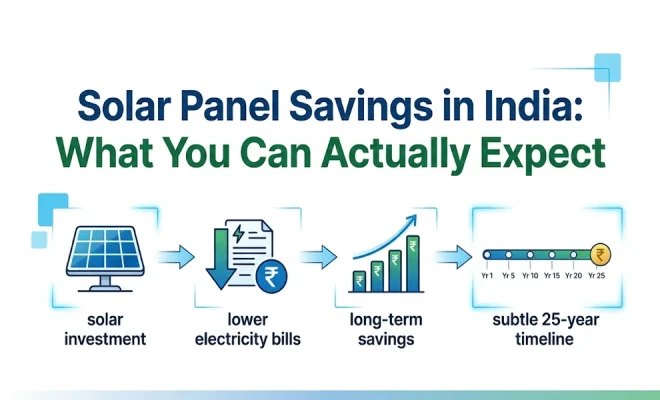
Solar Panel Savings in India: What You Can Actually Expect
Anyone considering solar eventually asks the same question: will this actually save me money, and by how much? The honest answer depends on your system size, your local electricity tariff, and how much sunlight your location gets, but current data gives a fairly clear picture of what to expect across different setups.
What a Typical Home Can Save
For an urban family, the current cost of a 3 kW system is ₹1.5 to 1.8 lakh including the subsidy benefit. For a monthly electricity bill of ₹2,500, savings achieved in the first year work out to be about ₹30,000, and taking into account that the rate of increase in the tariff is 4% to 5% per annum, the savings in the 25th year work out to be about ₹80,000. On average, the savings for the full 25-year life span of the system amount to about ₹14 lakh to ₹16 lakh, and the cost of the system is recovered in 5 to 6 years.
Does It Make Sense for a Factory or Business?
In the case of commercial installations, however, the math works out even more favorably owing to the higher consumption of electricity on part of businesses, as well as the proportionally larger absolute reductions in cost incurred. In the case of a commercial 10 kW installation, the total capital investment works out to be around ₹5.5-6 lakh, whereas the cost of electricity is around ₹1.8 lakh per annum. The savings will begin at ₹1.8 lakh per year initially and increase to close to ₹4.8 lakh per year by year 25, totaling to cumulative savings over 25 years of ₹60-70 lakh, and with payback period coming in at just 4 to 5 years.
For factories specifically, the size of the operation, its location, and how much energy it consumes all decide whether solar financing options make sense. An industrially oriented facility with higher energy consumption needs that is situated in a high solar radiation environment, such as Rajasthan or Gujarat, will have a shorter payback period than the other two categories.
Planning a 100kW Plant in a Factory
The initial step involved in the planning of such a facility is site assessment, where one would have to look into how much roof area or ground space is available, in addition to the orientation and whether there is any shading problem at the location. After determining the suitability of the site, the system sizing, panel types, and the inverter capacity would have to be determined based on the energy requirements of the factory. There is an important aspect of component selection where higher-quality panels and inverters come with higher costs but lower maintenance.
What Does a Commercial Solar Plant Actually Cost in 2026?
This may depend upon several factors, including size and type, but for the purpose of reference, a 1 MW commercial plant will cost somewhere between ₹3.5 crores and ₹4.5 crores, while a 10 MW plant will range anywhere between ₹35 crores and ₹45 crores. The type of panel will again be a deciding factor here, with N-type TOPCon panels being expensive yet efficient and slow to degrade, while Mono PERC panels are less expensive.
Financing Makes the Difference
For many businesses, the upfront cost is the biggest hurdle, which is exactly where solar loans and structured financing come in. Institutions like IREDA offer competitive solar panel financing for commercial projects, typically covering 70 to 75 percent of project cost at reasonable interest rates. On the residential side, several major banks now offer dedicated solar panel loans with manageable EMIs, often comparable to what a household would otherwise pay on its electricity bill. Government subsidies under schemes like PM Surya Ghar further reduce the effective upfront cost for homeowners, sometimes by up to 40 percent.
The Broader Picture
Apart from the immediate cost savings, solar systems usually have a lifespan of 25 years or more, implying that the true benefit accrues many times after the period of payback. One kilowatt of solar power produces about 1,300 to 1,500 units of energy each year in most areas of India.
If you are either an individual consumer or even a businessman, whether you own a factory, opting for 100 kW or even bigger, the choice of an appropriate solar loan and the right equipment supplier will make all the difference. With Waaree being the largest manufacturer of solar panels in India, having a total manufacturing capacity of over 25.8 GW, your needs will be fully addressed.