Solar Industry Market Trends: How TOPCon, HJT, BC, and Perovskite Technologies Drive Material Innovation
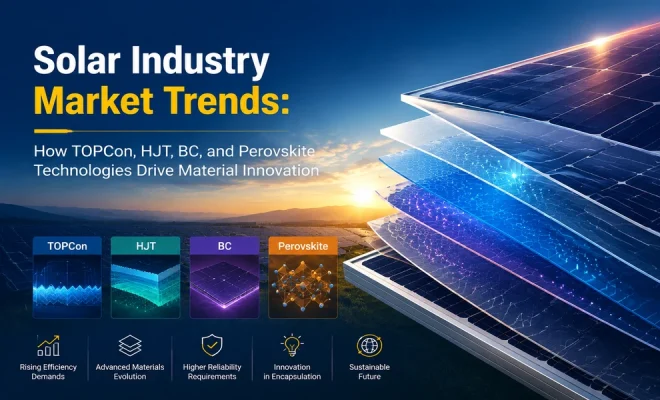
The global solar industry is entering a new phase of technological competition. Over the past decade, improvements in photovoltaic (PV) performance were mainly driven by larger wafers, higher-density cell layouts, and manufacturing optimization. However, as conventional PERC technology approaches its efficiency ceiling, the next generation of solar technologies-including TOPCon, HJT, Back Contact (BC), and perovskite-based tandem cells-is shifting the industry’s focus from cell architecture alone to advanced material systems.
Higher-efficiency solar cells create new challenges. Thin passivation layers, sensitive interfaces, higher operating voltages, and stricter reliability requirements mean that traditional materials may no longer provide sufficient protection. As a result, encapsulation films, backsheets, frontsheets, coatings, adhesives, and functional polymer materials are becoming critical factors in determining module performance and lifetime.
The future of solar competitiveness will not only depend on who produces the most efficient cells, but also on who develops the most reliable material solutions to support those technologies.
1. TOPCon: Driving Demand for UV Protection and PID-Resistant Materials
Tunnel Oxide Passivated Contact (TOPCon) technology has become one of the fastest-growing high-efficiency PV technologies due to its compatibility with existing PERC production lines and its potential for higher conversion efficiency.
However, the improved electrical performance of TOPCon cells also introduces new material challenges.
UV-Induced Degradation Becomes a Key Reliability Concern
TOPCon cells rely on advanced passivation structures, including ultra-thin oxide layers and silicon-based passivation films. These structures are highly effective for reducing carrier recombination but can be sensitive to long-term environmental stress.
In regions with strong solar radiation, such as deserts and high-altitude areas, prolonged UV exposure may accelerate degradation mechanisms and affect module power retention.
This creates increasing demand for:
- UV-blocking encapsulation films
- Light conversion materials
- Advanced polymer stabilization technologies
- High-transmittance protective layers
Modern TOPCon encapsulation solutions must balance two competing requirements:
Allow maximum sunlight transmission while filtering harmful UV radiation.
This has accelerated innovation in functional EVA, POE, and EPE encapsulation films designed specifically for high-efficiency modules.
Higher Voltage Requires Better PID Resistance
TOPCon modules often operate under higher system voltage conditions, increasing the importance of Potential Induced Degradation (PID) resistance.
Advanced encapsulation materials help reduce ion migration, especially sodium ion movement from glass into the cell structure.
Materials with:
- Lower water vapor transmission rates
- Improved ionic barrier properties
- Better electrical insulation
are becoming increasingly important for long-term TOPCon reliability.
2. HJT: Creating Demand for Ultra-Clean and High-Stability Encapsulation Systems
Heterojunction (HJT) technology represents another major pathway toward high-efficiency solar modules. By combining crystalline silicon with amorphous silicon layers, HJT achieves excellent passivation performance and temperature characteristics.
However, HJT’s advantages come with higher sensitivity to material compatibility.
Low-Temperature Processing Changes Material Requirements
Unlike traditional silicon cell technologies, HJT cells require lower-temperature manufacturing processes. This creates stricter requirements for encapsulation materials.
Traditional materials designed for conventional modules may not always provide optimal performance.
Future HJT encapsulation solutions need:
- Lower lamination temperature compatibility
- Reduced chemical interaction with cell surfaces
- Excellent adhesion stability
- Long-term optical performance
Optical Performance Becomes More Important
Because HJT cells already achieve high conversion efficiency, even small optical losses can affect module output.
This increases demand for:
- High-transparency encapsulation films
- Low-haze materials
- Light management technologies
- Anti-reflection and light conversion coatings
In the HJT era, encapsulation materials are no longer passive protective layers-they become active contributors to energy generation.
3. BC Technology: Increasing the Importance of Surface Protection and Reliability
Back Contact (BC) solar technology has attracted significant attention due to its excellent efficiency potential and aesthetic advantages.
Unlike traditional cells with front-side metal grids, BC cells place electrical contacts on the rear side, allowing the entire front surface to capture sunlight.
This architecture improves appearance and reduces shading losses but introduces new material challenges.
More Sensitive Cell Structures Require Better Protection
The front surface of BC cells contains advanced passivation and optical structures. Any degradation caused by moisture, UV radiation, or chemical interaction can directly impact performance.
Therefore, BC modules require encapsulation materials with:
- Excellent UV stability
- Low moisture permeability
- High optical transparency
- Strong interface adhesion
Aesthetic Applications Increase Material Expectations
BC technology is expected to expand in residential and architectural applications due to its clean appearance.
This creates opportunities for:
- Black encapsulation films
- Customized aesthetic solutions
- Transparent and lightweight protective materials
The future solar market will demand not only efficient modules but also visually integrated solar products.
4. Perovskite and Tandem Solar: The Next Frontier for Advanced Materials
Perovskite solar technology represents one of the most promising directions beyond traditional silicon photovoltaics.
Perovskite/silicon tandem cells have demonstrated extremely high efficiency potential by combining different light absorption ranges.
However, commercialization depends heavily on solving material stability challenges.
Moisture, Oxygen, and Thermal Stability Remain Key Challenges
Perovskite materials are highly sensitive to environmental conditions.
Exposure to:
- Moisture
- Oxygen
- UV radiation
- Thermal cycling
can accelerate degradation.
Therefore, perovskite encapsulation solutions require advanced protection systems, including:
- High-barrier encapsulation films
- Specialized adhesives
- Edge sealing technologies
- Multi-layer protection structures
Unlike conventional PV modules, perovskite applications may require encapsulation systems designed at the molecular level.
Polymer Innovation Supports Tandem Commercialization
Advanced polymer technologies can help improve:
- Interface stability
- Mechanical durability
- Chemical resistance
- Long-term module reliability
As tandem technologies move toward mass production, material suppliers will play an increasingly important role in enabling commercialization.
5. The Future Solar Supply Chain: Materials Become a Competitive Advantage
The next generation of photovoltaic technologies will not be defined by cells alone. Instead, the industry is moving toward integrated innovation across:
- Cell technology
- Encapsulation materials
- Protective films
- Adhesive systems
- Module design
For manufacturers, selecting the right material partner will become as important as selecting the right cell technology.
Companies developing advanced PV materials must provide:
As TOPCon, HJT, BC, and perovskite technologies continue to evolve, material innovation will determine how efficiently, reliably, and sustainably solar energy can scale worldwide.
Conclusion
The solar industry is entering a material-driven innovation era.
- TOPCon requires stronger UV protection and PID resistance.
- HJT demands cleaner and more compatible encapsulation systems.
- BC technology requires advanced optical and protective materials.
- Perovskite tandem cells depend on breakthrough barrier and stabilization solutions.
The future winners in photovoltaics will not only manufacture higher-efficiency cells-they will create the complete material ecosystem that allows these technologies to achieve their full potential.