Why Indian Educational Institutions Are Choosing Apple Enterprise Solutions
Indian schools, colleges, and universities are making deliberate choices about the technology they bring into their classrooms. And increasingly, that choice is Apple. The shift is not about prestige or brand preference. It comes down to what Apple Enterprise Solutions offer that most alternatives do not: a complete ecosystem where hardware, software, management, and support all work together without friction.
For institutions that are trying to serve hundreds or thousands of students at once, that kind of cohesion matters more than any single feature.
Here is why more educational institutions across India are moving in this direction.
The Infrastructure Challenge That Apple Solves
Running technology across a school or university is not a small undertaking. Devices need to be set up, maintained, updated, and secured. Staff need tools that help them teach without spending half their time troubleshooting. Students need reliable hardware that works the same way every time.
Apple addresses this through Apple School Manager, a free web-based platform that allows IT teams to enrol and configure devices automatically, distribute apps and content, and manage accounts from a single dashboard. When a new student joins, their iPad or MacBook can be ready to use before they even open the box.
For larger institutions managing thousands of devices across campuses, this level of control is not a luxury. It is a necessity.
Devices Built for Learning Environments
The iPad remains the most widely adopted Apple device in Indian educational settings, and for straightforward reasons. It is lightweight, durable, intuitive for students of all ages, and compatible with Apple Pencil, which transforms note-taking, sketching, and annotation.
Apps like Goodnotes, Notability, Keynote, and Pages are built to take advantage of the Apple Pencil in ways that go well beyond typing. Students in architecture programmes sketch directly on screen. Medical students annotate 3D anatomical models. Engineering students collaborate on diagrams in real time.
MacBook Air, particularly with the M-series chip, has become the preferred option for higher education institutions. The combination of all-day battery life, fanless silent operation, and performance that handles video editing, coding, and data analysis makes it a practical choice for students across disciplines.
Enterprise Apple Deployment at an Educational Scale
What makes Apple genuinely suitable for institutions is how well its deployment tools hold up at scale. Enterprise Apple deployment, when applied to educational environments, means that IT teams can roll out hundreds of devices simultaneously without any manual configuration.
Automated Device Enrollment through Apple School Manager means every device, whether it is an iPad for a school in Mumbai or a MacBook for a university lab in Chennai, arrives pre-configured with the apps, restrictions, and settings the institution has defined. Nothing extra needs to be done on the device itself.
This reduces the burden on IT teams significantly, and it means new academic years or new campus expansions do not require weeks of setup work.
Security and Privacy That Institutions Can Trust
Educational institutions handle a significant amount of sensitive data, from student records and assessments to staff communications and financial information. Apple devices are built with security at the hardware level, not added on as an afterthought.
Features like Face ID, end-to-end encryption, and Secure Enclave mean that student data stays protected even if a device is lost or stolen. Mobile device management tools allow IT teams to remotely wipe or lock a device instantly. And because Apple Intelligence processes most tasks on the device itself rather than sending data to servers, privacy is maintained by design.
According to Jamf, which provides device management for Apple in education settings, 35% of all security breaches globally take place in higher education. This makes robust, built-in security not just a preference but a responsibility.
Apple’s Commitment to India’s Education Ecosystem
Apple is not just selling devices to Indian institutions. It is putting money and effort into building skills that last.
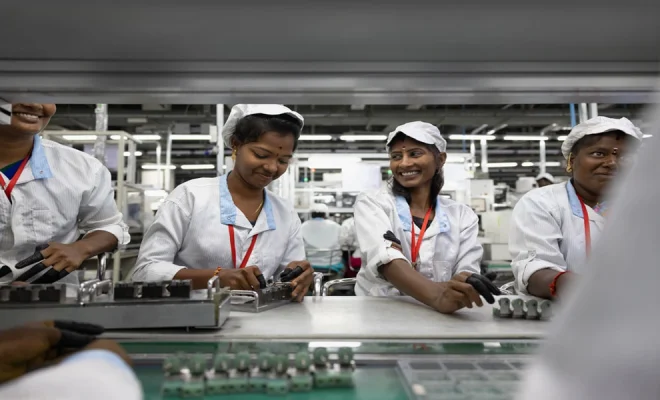
In February 2026, Apple opened a dedicated Education Hub in Bengaluru, working alongside the Manipal Academy of Higher Education. The focus is practical: training supplier employees in coding, robotics, digital skills, and smart manufacturing. Instructors are trained first, and they then carry that knowledge into supplier facilities across the country.
More than 75 courses are currently available for supplier employees in India, covering everything from technical skills to professional development, with specific programmes designed for persons with disabilities.
That kind of commitment is harder to walk away from than a product catalogue. Apple is building roots in Indian education, not just a customer base.
What the Right Partner Makes Possible
Access to Apple devices is one part of the equation. Having a partner who understands how to deploy and manage them across an institution is the other. The Apple business technology solutions that work well in educational settings are the ones that have been configured properly from day one, with the right apps, the right restrictions, and the right support model behind them.
Institutions that invest in this kind of setup find that the technology becomes invisible in the best possible way. It stops being a source of problems and starts being the thing that makes learning happen.
As an Apple Authorised Partner, iPlanet Enterprise helps schools, colleges, and universities design, deploy, and manage Apple ecosystems at scale. From consultation and device procurement to enterprise deployment, mobile device management, and ongoing support, institutions receive end-to-end assistance tailored to their learning environment.